
Want to find music app that matches your taste and routine? This guide will help you make a clear choice. It breaks down features, costs, and tests to try so you can pick with confidence.
Reading will take a few minutes. You will learn what to check and how to compare services. By the end, you will know which music app fits your listening life.
Key features to check
The right app gives you tools you will actually use. Think about playback controls, playlists, and offline listening. These basics shape your daily listening experience.
Look for features that match your habits. If you like playlists, pick an app with easy playlist creation and editing. If you use multiple devices, check how the app syncs across them.
Read the next paragraph before you see a short checklist. The checklist points out the most useful features to compare quickly.
Here are the key features to rate when you try an app. Use this list as your quick comparison sheet.
- Library size – How many songs, podcasts, and live tracks are available.
- Offline listening – Can you download music for travel or poor signal areas?
- Playlists and organization – How easy is it to build, sort, and share playlists?
- User interface – Is the app clear and fast on your phone and computer?
- Cross-device sync – Does playback and your library stay in sync across devices?
Free vs paid plans
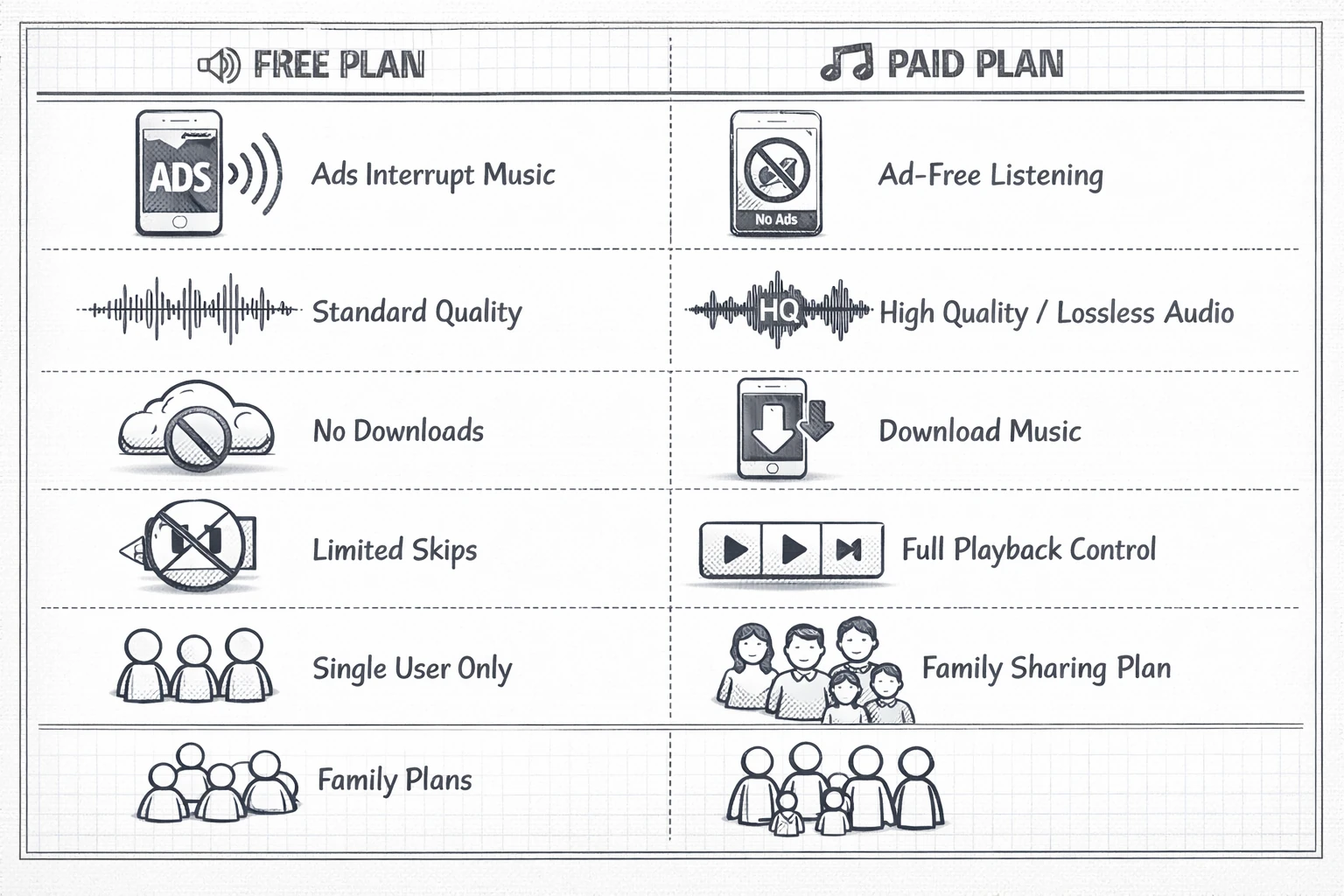
Decide how much value you need from a music app. Free plans often have ads and limited features. Paid plans remove ads and add features like higher audio quality and offline downloads.
Think about how often you listen and where. If you only stream sometimes at home, a free plan might work. If you commute or want offline music, a paid plan usually makes sense.
Below is a quick list showing common trade offs between free and paid plans. Read it and weigh which trade offs matter most to you.
Compare these points when you test apps so you can see the real difference between free and paid tiers.
- Ads – Free plans usually have ads that interrupt music. Paid plans remove ads.
- Audio quality – Paid plans often offer higher bitrate or lossless options for clearer sound.
- Offline mode – Paid plans let you download music to play without internet.
- Playback control – Free plans may restrict skips or limit on-demand plays.
- Family plans – Paid family plans let several people share one subscription at a lower per-person cost.
Library size and device support
Library size matters but is not everything. Large catalogs give you more chance to find rare tracks. But many apps have similar core catalogs for popular music.
Device support is key. Make sure the app works on your phone, tablet, computer, smart speaker, and car system. If an app fails on one device you use, it will be frustrating.
Read the short list below to check compatibility and library factors before you commit to a service. This helps you avoid surprises later.
Use this checklist to verify library and device coverage quickly while you try apps.
- Catalog depth – Does the app carry the artists and genres you love, including local or niche music?
- Format support – Does it play common formats and offer high-resolution or lossless files if you want them?
- Device apps – Is there a native app for your operating systems and hardware?
- Car and smart devices – Does it integrate with car infotainment, wearables, and smart speakers?
Sound quality and data use
Audio quality is simple to check, but it matters more for some listeners. Casual users may not notice small differences. Audiophiles will want higher bitrates or lossless files.
Also think about data. Higher quality streams use more mobile data. If you have a limited plan, look for automatic quality settings or easy downloads to save data.
Before you test an app, read the brief guide below. It lists typical quality tiers and what they mean for listening and data use.
Use this list to match audio settings to your gear and data limits so you get the balance you want.
- Standard quality – Lower data use and fine for casual listening on phone speakers.
- High quality – Better clarity on good headphones, uses more data.
- Lossless – Studio-like detail for high-end systems, requires more storage and data.
- Adaptive streaming – Automatically adjusts quality based on your network to save data.
Music discovery and personalization
Discovery tools help you find new songs and keep your playlists fresh. Good apps learn your taste and suggest tracks you are likely to enjoy. This saves time and keeps listening fun.
Check how the app personalizes your feed. Some services offer daily mixes, radio-style stations, or playlists based on mood. See which approach matches how you like to find new music.
Below is a short list of discovery features to look for. These features can change how quickly you find songs you love.
Try apps with different discovery methods and compare how accurate the suggestions feel to your taste.
- Curated playlists – Human-made lists for genres, moods, and activities.
- Algorithmic mixes – Playlists built by models that learn from your listening.
- Radio or stations – Continuous play based on an artist or track.
- Editorial content – Articles, podcasts, or show notes that explain music and suggest related tracks.
Social, family, and offline features
Think about who else uses your music service. Family plans can save money and let everyone keep personal playlists under one bill. Social sharing can make music more fun with friends.
Offline features are important for travel and areas with poor signal. Make sure the app lets you easily download and manage offline music. Also check limits on the number of offline songs or devices.
Use the list below to check social and offline tools when testing an app. These features affect daily convenience and sharing.
Review each item in the list as you try apps so you know what will work for family use or sharing with friends.
- Family and student plans – Lower price options that cover multiple accounts or students.
- Shared playlists – Can friends and family add to the same playlist?
- Offline limits – How many devices and songs can you download?
- Social integrations – Can you share listening activity or collaborate with others?
How to test and pick the best app
Testing is the best way to find music app that fits you. Most services offer free trials or free tiers. Use real listening sessions to see how each app behaves with your routine.
Make a short testing plan. Use each app for a week with the same listening tasks. Play the same playlists, try discovery features, and test downloads. Keep notes on what feels smooth or annoying.
Below is a simple checklist to guide a fair test. Follow it and you will have clear reasons to choose or reject an app.
After your test, compare your notes and pick the app that meets your needs best. This method makes the choice clear and avoids buyer regret.
- Try core features – Playlists, playback, downloads, and sync across devices.
- Test discovery – Use weekly mixes and suggestions to see how well they match your taste.
- Check data use – Stream on mobile to judge how much data high quality uses.
- Evaluate price – Compare the value of paid plans, family options, and student discounts.
Key Takeaways
Finding the right app is about matching features to your habits. Think about playback, offline use, device support, and discovery when you compare services. These items shape day to day listening.
Try services with a plan for testing. Use the checklists in this guide to compare features, sound, and price. Testing saves time and helps you choose a long term app you enjoy.
Keep this in mind as you search: the best pick is the one that fits your life and makes listening simple. Use this guide to find music app and start enjoying your music more today.
